
WhaT is an ai-ready home?
A complete guide for 2027
Smart Home vs. AI-Ready Home: What's the Difference?
If you've shopped for a new home recently, you've probably seen the phrase "smart home" on more listings than you can count. But a growing number of builders are now using a different term: AI-ready home. It sounds like marketing language, and sometimes it is — but the concept behind it is genuinely useful, and worth understanding whether you're buying a home, selling one, or building one.
A "smart home" usually means a house with a handful of connected devices already installed — a video doorbell, a smart thermostat, maybe a voice assistant hub. Those are products. You can buy them at any hardware store and add them to almost any house in an afternoon.
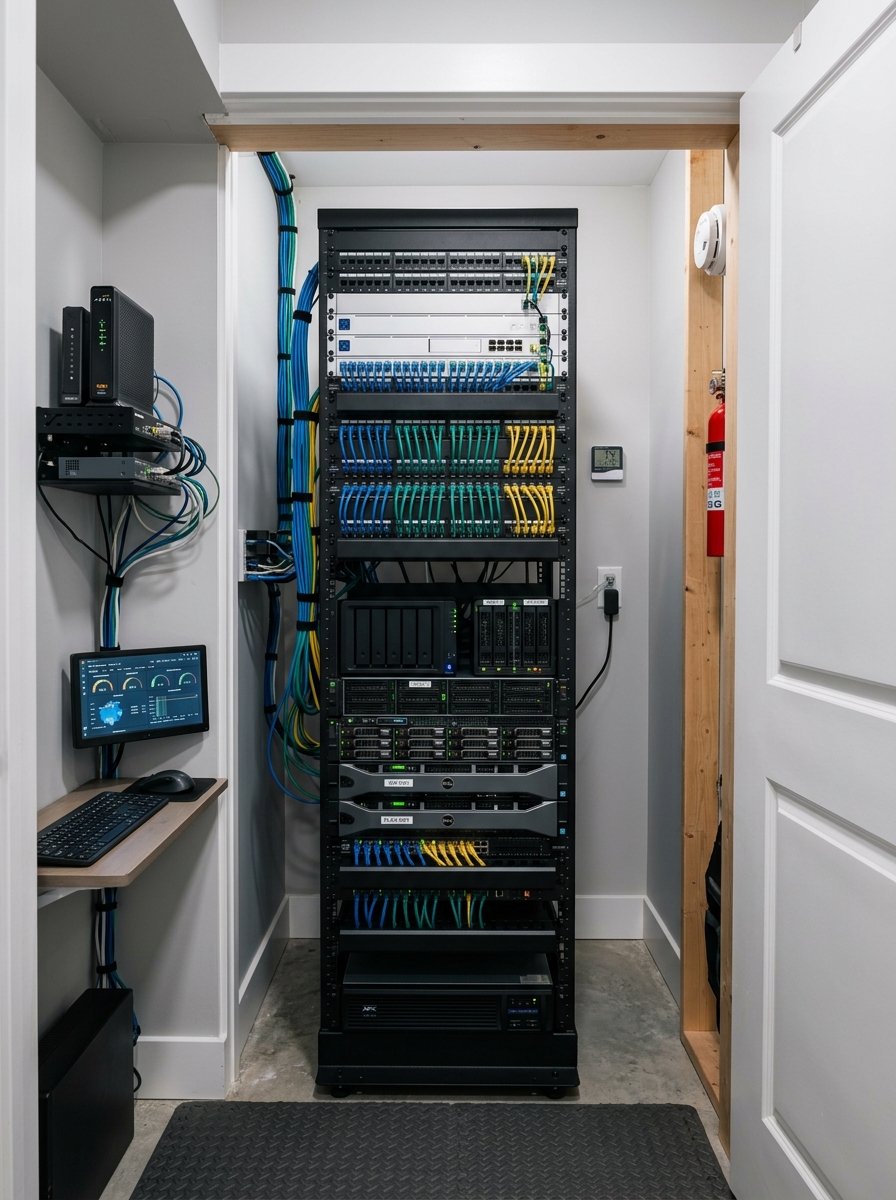
An AI-ready home is different. It's not about which devices are installed on move-in day — it's about whether the infrastructure behind the walls can support what you'll want to add over the next ten years: more sensors, higher bandwidth, an EV charger, a home battery, maybe even a server closet for local AI processing. This infrastructure includes:
The distinction matters because devices change every two or three years, but the wiring and conduit behind your walls are effectively permanent. A smart-device bundle is easy to add later. A missing electrical panel upgrade or a Cat6 run that was never pulled is not... not without tearing into finished walls.
03
Electrical capacity — a panel sized for future loads, not just today's appliances
04
Network backbone — enough bandwidth and access points to support dozens of connected devices without the Wi-Fi buckling
02
HVAC and plumbing sensors — wiring in place for leak detection, zoned climate control, and air-quality monitoring
01
Structured wiring — Ethernet and low-voltage cabling run to the right rooms during framing, before drywall closes them off
Why This Matters Right Now
A few trends are converging at once, and they're the reason "AI-ready" is showing up in builder marketing instead of staying a niche concept:
AI is moving into the physical home. Industry analysts have flagged AI-driven HVAC systems, predictive maintenance sensors, and unified building intelligence platforms as some of the fastest-growing categories in residential technology for 2026. These systems need always-on power, local processing capacity, and reliable connectivity — things a 2015-era electrical panel wasn't built for.
EV ownership is normalizing. The majority of EV charging already happens at home rather than at public stations, and that share is growing. A home without a dedicated 240V circuit in the garage means a costly retrofit — or an owner who charges more slowly than they'd like.
Buyers are already asking for it. Surveys of home shoppers have found that a majority would pay more for a home with smart-home infrastructure already in place, and some studies put the perceived value add in the tens of thousands of dollars. Buyers aren't just tolerating this trend — they're actively looking for it.
What to Look For, If You're Buying?
What size is the electrical panel, and is there room to add circuits later?
A 200A panel with no spare capacity is a red flag if you plan to add an EV charger or battery storage down the road.
Is there a structured wiring panel, and how many Cat6 runs come standard?
This is the physical backbone of your home network — more runs now means fewer dead zones later.
Is there a dedicated circuit, or at least a conduit stub, for EV charging?
Even if you don't own an EV yet, this is one of the most expensive things to retrofit.
The bottom line
For builders and developers, the opportunity is less about any single device and more about treating infrastructure as a product line — something buyers can select and upgrade, rather than a fixed spec every home gets or doesn't. A tiered approach (a baseline "future-proofed" spec on every home, with upgrade packages for buyers who want more) tends to outperform an all-or-nothing smart-home bundle, because it lets the builder capt
"AI-ready" isn't a single feature you can point to — it's a description of how a home was wired and provisioned during construction, before the walls closed. That makes it one of the few genuinely durable differentiators left in a new-home market where floor plans and finishes increasingly look the same from builder to builder. Whether you're buying your next home or building the next phase of a community, the rough-in decisions made before drywall are the ones that are hardest — and most expensive — to undo later.